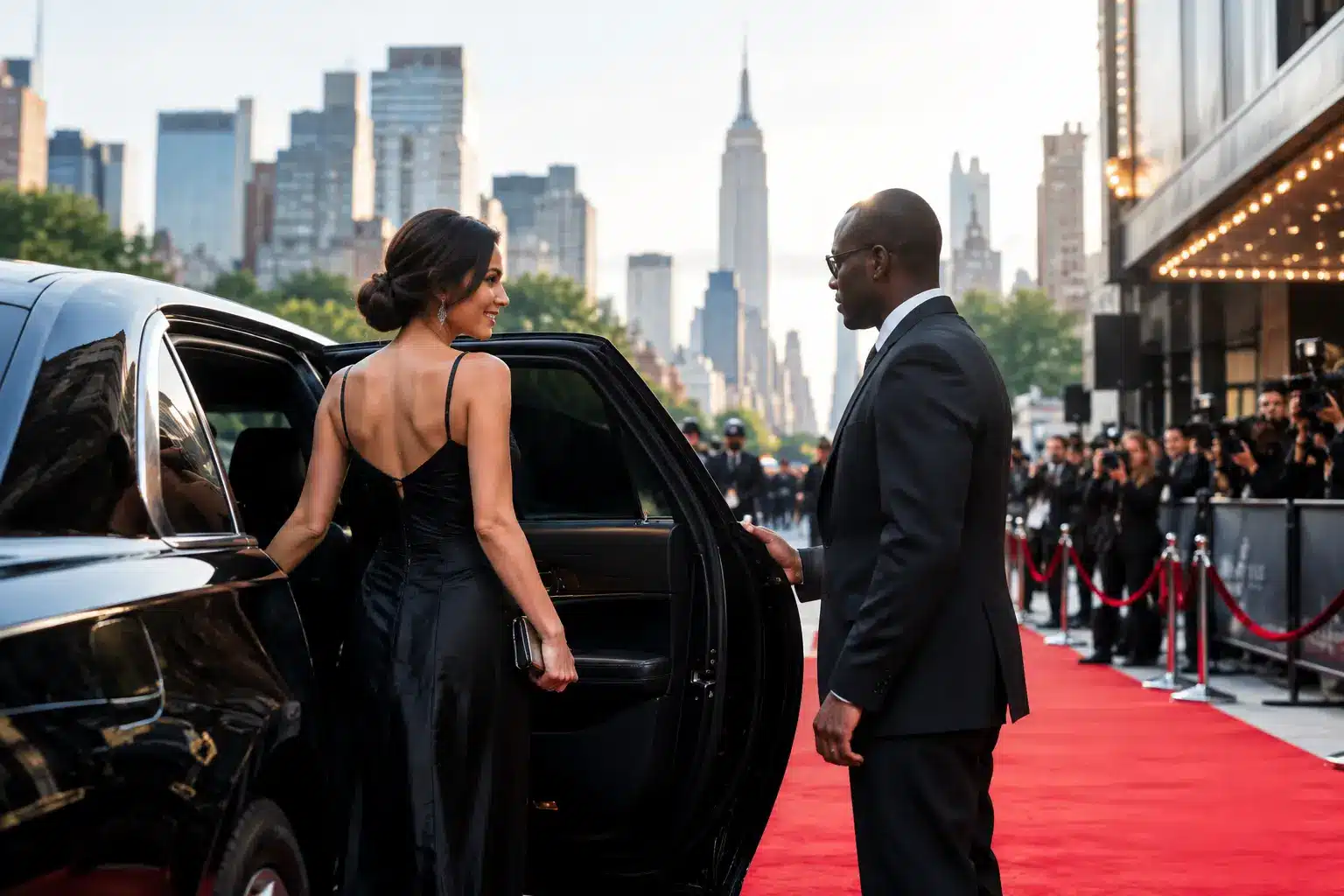
A film premiere is not simply an evening reservation. It is a moving production with public arrivals, restricted access, changing call times, security considerations, and little tolerance for a missed cue. NYC film premiere transportation should be planned with the same discipline as the event itself: clear schedules, appropriate vehicles, professional chauffeurs, and a live point of contact who can respond when the plan changes.
For talent, studio executives, producers, investors, press teams, and invited guests, the vehicle is the final private space before the cameras and the first one after the crowd disperses. The right chauffeur service protects that moment with discretion, timing, and calm execution.
Why Premiere Transportation Requires More Than a Pickup
A Manhattan premiere can involve a theater arrival window, red-carpet staging, street closures, hotel departures, after-party transfers, and staggered guest movements across several hours. The most visible part of the night may last minutes. The logistics behind it rarely do.
Traffic conditions around Midtown, Lincoln Square, Tribeca, or a premiere venue can change quickly. A route that works during a site review may be restricted on event night. Police activity, production vehicles, press barricades, and pedestrian congestion can alter where a car may wait or release passengers. An experienced transportation partner plans for the official arrival point while maintaining practical alternatives nearby.
This is why a chauffeur should not arrive with only an address. They need the correct entrance, the permitted approach route, the guest’s preferred name, the event contact, vehicle credentials if required, and instructions for post-event pickup. Details that appear minor on a normal evening become decisive when a vehicle must be positioned precisely and the guest cannot wait curbside.
Building an NYC Film Premiere Transportation Plan
The strongest transportation plans begin before vehicle selection. Start with the guest manifest and divide it by movement, not status alone. A lead actor may require a controlled red-carpet arrival and a separate departure strategy. A studio executive may need an airport transfer, hotel transfer, premiere arrival, and dinner afterward. A group of guests may be best served by an executive sprinter or motorcoach rather than individual sedans.
Each movement should have a scheduled departure time, a preferred arrival time, a pickup address, a primary contact, and a contingency note. For high-profile guests, include a designated representative who can communicate directly with dispatch or the chauffeur. That prevents talent, executives, or assistants from having to manage transportation decisions while handling an active event.
Choose Vehicles for the Moment
A luxury sedan is often the right choice for individual executives, producers, and VIP guests who value a quiet, discreet arrival. An SUV provides added passenger and luggage capacity, making it practical for a small party, security personnel, or guests arriving from an airport or hotel.
Executive sprinters are particularly useful for cast groups, production leadership, family members, and teams moving between a hotel, premiere, and private reception. They keep the group together, reduce the number of curbside movements, and create a more orderly departure at the end of the evening. For larger invited groups, motorcoaches can simplify guest transportation from a designated gathering point.
The decision depends on the venue’s curb space and the event’s arrival protocol. Larger vehicles offer operational advantages, but they require more room to stage and may have different access limitations. A transportation coordinator should confirm those details with the venue or event lead rather than assume the same plan works at every theater.
Build Time Into the Schedule Without Making Guests Wait
Premiere clients expect punctuality, but punctuality is not merely arriving at the pickup address at the stated time. It means allowing for elevator delays, hotel loading areas, security checks, wardrobe adjustments, and the natural unpredictability of an event night.
A professionally managed reservation includes a sensible buffer before the required arrival window. The guest should feel collected, not rushed. At the same time, the chauffeur should avoid early curbside activity that attracts unnecessary attention or blocks a sensitive entrance. Good timing is measured, quiet, and deliberate.
For airport-to-premiere movements, the buffer should be more generous. International arrivals, baggage handling, and traffic from JFK, LaGuardia, Newark, Teterboro, or Westchester can introduce variables outside anyone’s control. A chauffeur service with 24/7 dispatch can monitor the trip and adjust the plan before a delay becomes an event-night problem.
The Value of Discretion at High-Visibility Events
Privacy is a practical requirement, not an added flourish. Guests may review talking points, take private calls, change footwear, decompress after a press line, or simply want a quiet ride away from the venue. The vehicle, chauffeur, and dispatch team should respect that space without prompting or intrusion.
TLC-licensed, fully insured chauffeurs bring an essential level of professionalism to this work. They understand that discretion includes language, posture, route choices, and communication. The goal is not to become part of the evening. It is to make the guest’s transportation feel controlled from the moment the door opens.
This standard also matters for assistants and event planners. A clear chauffeur point of contact, accurate vehicle information, and dependable confirmation procedures reduce unnecessary calls and messages. When a schedule shifts, the planner needs a direct operational response, not uncertainty.
Departure Is Often the Hardest Part
The red carpet gets attention, but the departure is usually more complex. Guests leave at different times. Some attend a private dinner or after-party. Others need to return to a hotel, airport, residence, or another event. Street access may be tighter once pedestrians, press, and venue traffic converge after the screening.
A successful departure plan identifies where each vehicle will stage, who will release the guest, and what happens if the primary curb is temporarily inaccessible. For top-tier clients, the chauffeur may need to reposition based on instructions from security or venue personnel. That requires active coordination, not a static reservation.
It also helps to establish a simple pickup protocol before the event begins. The guest or representative should know whether to call, text, or meet the chauffeur at a designated point. If the event team is handling releases, dispatch should have that contact in advance. Clarity protects privacy and prevents a guest from standing outside while searching for the right vehicle.
When One Provider Makes the Evening Easier
A premiere may begin days earlier with executive arrivals, airport transfers, hotel transportation, and site visits. It may continue after the screening with private dining, next-day meetings, or departures to another city. Managing these movements through one professional transportation partner gives the planner a consistent service standard, one operating team, and simpler billing.
NYC Drivers coordinates luxury chauffeur service across New York City, the Tri-State Area, and a broader national and international network. For production offices, corporate teams, and executive assistants, that reach can be especially useful when a New York premiere is only one part of a larger travel itinerary.
The best plans still account for trade-offs. A tightly controlled arrival may call for separate vehicles rather than a shared group transfer. A guest list that changes late may require flexible hourly coverage. A major venue may have access rules that make the closest curb impractical. The answer is not one standard package. It is a plan built around the event’s actual schedule, guest profile, and security needs.
Reserve Early, Then Confirm the Details
For a major premiere, reserve transportation as soon as the event date, hotel block, and venue are known. Early planning offers more fleet flexibility and allows time to coordinate staging requirements. It is particularly valuable when the event needs multiple vehicle types, recurring transfers, or specialized arrangements.
In the final days, reconfirm the itinerary with the event contact. Verify names, mobile numbers, pickup locations, arrival windows, baggage needs, and post-event destinations. A concise final run sheet gives everyone confidence without burdening guests with logistics.
A film premiere should feel effortless to the people attending it. That feeling is earned well before the carpet, through disciplined planning, discreet chauffeurs, and transportation that is ready when the evening asks more of it.
Leave a Reply