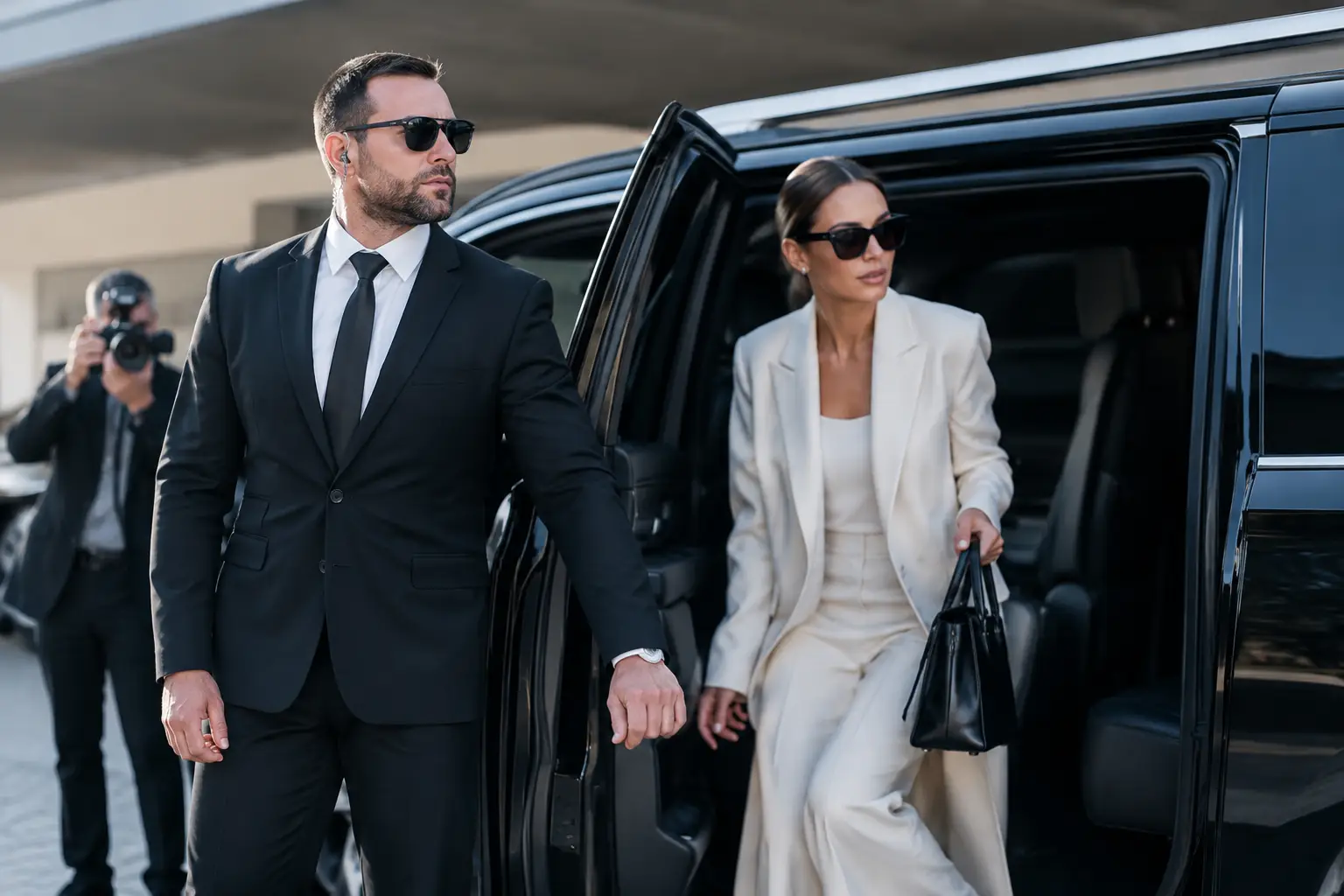
A celebrity arrival is not simply a vehicle pulling up to a curb. It is a tightly managed sequence involving privacy, timing, access, communications, and a clear handoff from transportation to venue security. Knowing how to secure celebrity arrivals means designing that sequence before the guest is in motion, not reacting once cameras, crowds, or traffic begin to build.
For executive assistants, event producers, security teams, and private hosts, the objective is straightforward: the principal should arrive calm, on time, unexposed, and fully supported. The details that create that outcome are rarely visible to the guest. That is precisely the point.
Start With an Arrival Plan, Not a Pickup Time
A secure arrival begins with a written operational plan shared only with the people who need it. A pickup address and event start time are not enough. The transportation coordinator, designated security lead, venue contact, and principal’s representative should agree on the arrival window, approved access point, vehicle staging area, entry route, and post-arrival handoff.
The plan should also establish who has authority to make changes. High-profile schedules shift quickly due to delayed flights, press obligations, weather, or last-minute program changes. When several people issue instructions independently, confusion follows. Assign one point of contact for the principal’s team and one for the transportation operation. Every update should move through those two individuals.
Discretion is essential at this stage. Do not distribute itineraries broadly, name the guest unnecessarily on driver manifests, or circulate vehicle details to vendors who do not require them. The best plans are specific without being widely visible.
Choose Professional Chauffeured Transportation
The vehicle is part of the security environment. It should be selected for more than appearance. A properly maintained luxury sedan or SUV may be appropriate for a single principal moving through Manhattan, while an executive sprinter may better suit an entourage, management team, or security detail traveling together.
More important than the vehicle category is the service behind it. Use a fully licensed, insured chauffeur operation with experienced dispatch support and chauffeurs accustomed to confidential, high-touch assignments. The chauffeur must understand that their role is not to seek attention or improvise around a principal. Their responsibility is to execute the approved plan, maintain professional awareness, and communicate promptly through designated channels.
For higher-risk profiles or sensitive public appearances, transportation should be coordinated with licensed security professionals. A chauffeur service supports the movement plan, while the security team determines protective protocols, threat considerations, and venue procedures. Those roles should complement each other rather than overlap.
Build the Route Around Conditions, Not Assumptions
A route that looked efficient at noon can become unusable by evening. Street closures, demonstrations, construction, sporting events, film production, and sudden congestion can change access around a venue with little notice. Secure celebrity arrivals require active monitoring and the flexibility to adjust before the vehicle reaches the final blocks.
The primary route should be agreed upon in advance, with a practical alternate route and alternate entrance when the venue allows it. The purpose is not to create unnecessary complexity. It is to avoid a situation where the vehicle is forced to stop in public while the team decides what to do next.
At airports, this planning matters even more. A commercial terminal arrival at JFK, LaGuardia, or Newark can involve flight delays, terminal congestion, baggage timing, and changing pickup restrictions. For private aviation, FBO procedures and ramp access requirements must be confirmed in advance. The chauffeur and dispatch team should receive accurate flight information and wait instructions, while the principal’s team confirms whether a direct curbside transfer or a private meeting location is preferred.
Time the Arrival Window Carefully
Early is generally better than rushed, but arriving too early can create its own exposure. A vehicle waiting at a highly visible entrance may draw attention before the principal is ready to exit. A secure plan accounts for a controlled holding location nearby, then releases the vehicle toward the final approach only when the venue is prepared.
This is where a 24/7 dispatch operation adds real value. Dispatch can track schedule changes, stay in contact with the chauffeur, and coordinate arrival timing without turning the principal into the source of every update.
Control the Arrival Zone
The last 100 feet often determine whether an arrival feels composed or chaotic. The venue should identify where the vehicle will stop, who will be present, where doors will open, and how the principal will move from the vehicle into the building.
Whenever possible, use a secure or limited-access entrance rather than the main public entry. A service entrance is not automatically the right choice – it may be poorly lit, operationally crowded, or unsuitable for a VIP arrival. The selected entrance should be evaluated for privacy, lighting, surface conditions, staff access, and the ability to move the guest quickly indoors.
The arrival zone needs clear ownership. Venue security manages the entrance and interior transition. The chauffeur manages the vehicle until the principal has exited. A representative from the principal’s team confirms the handoff. When those responsibilities are understood, there is no hesitation at the curb.
If press or invited photographers are part of the event, define their placement and timing in advance. Media access should be intentional, not an accidental byproduct of poor crowd management. A public-facing entrance can work well for a planned appearance; it is a poor choice for an unannounced or privacy-sensitive guest.
Keep Communications Quiet and Direct
Secure operations rely on concise communication. Teams need to know the status of the arrival without broadcasting details. Use agreed-upon contacts and simple status updates such as vehicle en route, vehicle staged, principal onboard, and principal delivered. Avoid sharing live location details in large group messages or informal channels.
The chauffeur should not contact the celebrity directly unless that arrangement has been specifically approved. Communication should move through the assistant, road manager, security lead, or designated travel coordinator. This protects the guest’s privacy and prevents conflicting instructions while the vehicle is moving.
It also helps to confirm names, phone numbers, and vehicle details on the day of service. An outdated contact list can delay an otherwise well-planned arrival. For an event with multiple VIPs, each party should have a separate movement plan rather than relying on a single group thread and broad assumptions.
Prepare for Delays Without Creating Drama
No event plan is immune to change. A delayed flight, a blocked entrance, an unexpected crowd, or a principal who needs additional time can alter the schedule immediately. The question is not whether something may shift. It is whether the team can adapt without exposing the guest or disrupting the event.
A strong contingency plan identifies the alternatives before they are needed. That may include a secondary entrance, a nearby holding location, a revised drop-off point, or a delayed vehicle release. For complex events, the security lead and transportation coordinator should conduct a brief pre-event walkthrough or call to confirm these options.
Avoid overcorrecting. A high-profile guest does not need an oversized operation for every dinner, meeting, or private appearance. The appropriate level of planning depends on the guest’s profile, venue, timing, expected public interest, and the nature of the event. Quiet competence is often more effective than a conspicuous display.
Choose a Transportation Partner That Understands Discretion
Celebrity and VIP transportation is a service of details: a clean, properly appointed vehicle; a chauffeur who arrives early; dispatch that remains available; and a team that respects confidentiality without needing to be reminded. The provider should be able to coordinate with assistants, security professionals, venue managers, and aviation teams while keeping the experience composed for the passenger.
NYC Drivers supports high-profile movements with professional chauffeurs, luxury vehicle options, and around-the-clock dispatch coordination for New York City events, airport transfers, and travel across New York City and the Tri-State area. For clients managing complex schedules, one accountable transportation partner can reduce the number of handoffs and the opportunity for errors.
The strongest celebrity arrival is the one that receives no attention for the wrong reasons. When transportation, venue access, and protective planning work as one operation, the principal steps out, moves inside, and begins the engagement exactly as intended.
Leave a Reply