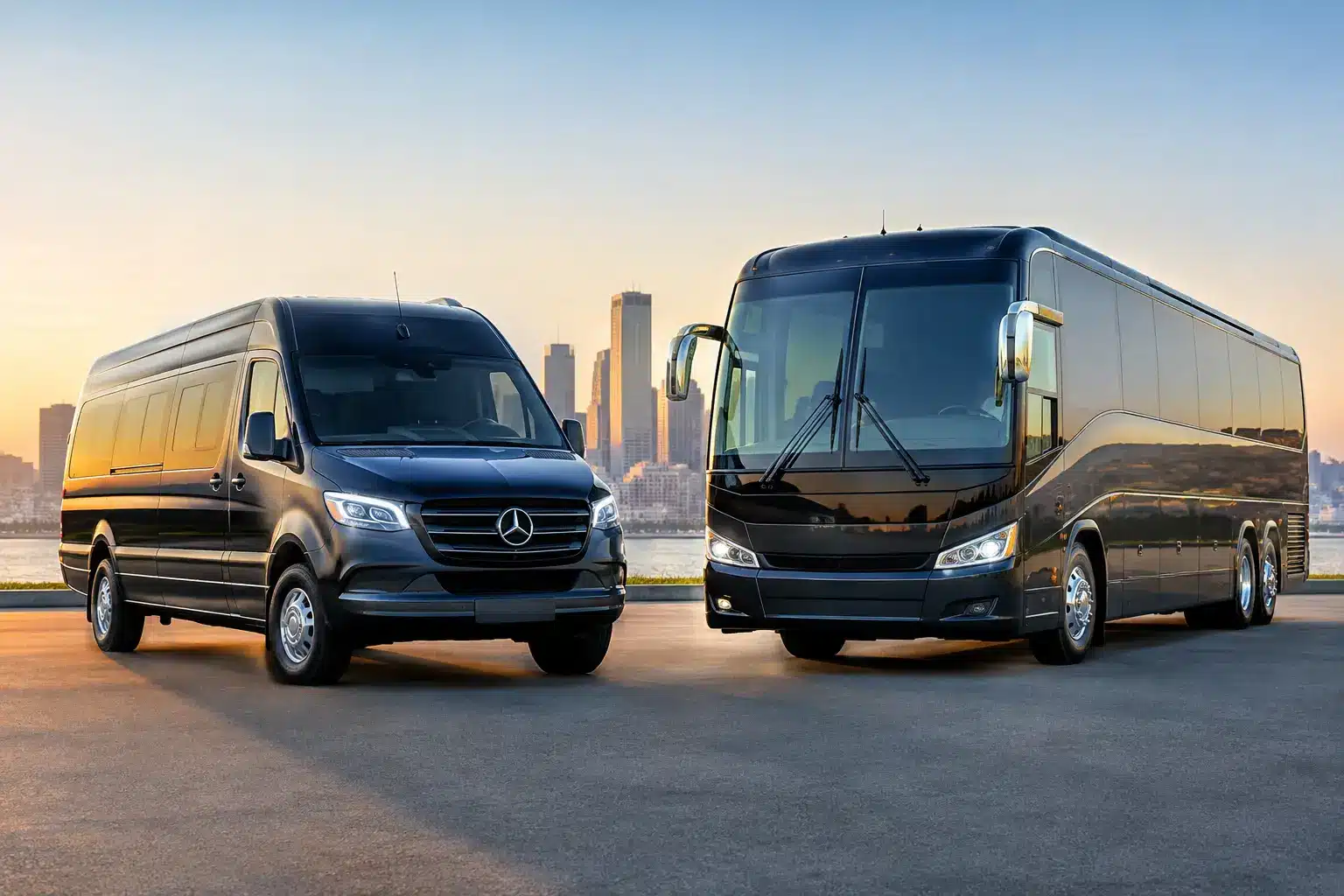
A transportation plan can feel flawless on paper and still fail at the curb. The usual cause is not the route or the reservation time. It is choosing a vehicle that does not match the group, the luggage, or the pace of the day. In the sprinter versus motorcoach decision, capacity matters, but so do arrival experience, access, privacy, and how easily guests can move through New York City.
An executive sprinter is designed for smaller groups, typically accommodating 8 to 14 passengers, offering a private and refined environment with flexibility and direct door-to-door access. A motorcoach is built for larger movements, commonly carrying 30 to 56 passengers, and is ideal for keeping a large group together. Sprinters are often preferred for executive teams, VIP delegations, or itineraries with frequent stops in urban areas like Manhattan due to easier curb access. Motorcoaches are the operational answer when the primary goal is to transport a significant number of guests, such as 50 guests to a gala or convention, ensuring everyone arrives together.
For an executive team flying into Teterboro, a small delegation moving between Manhattan meetings, or a large conference group arriving at JFK, the right vehicle should make the itinerary feel controlled from the first pickup. The wrong one can create unnecessary waits, split a group that should travel together, or make a formal occasion feel less considered.
Sprinter Versus Motorcoach: The Essential Difference
An executive sprinter is designed for smaller groups that expect a private, refined environment. It is a premium van-based vehicle, typically configured for approximately 8 to 14 passengers depending on seating layout and luggage requirements. A motorcoach is built for larger movements, commonly carrying 30 to 56 passengers, with configurations that vary by coach and trip type.
The distinction is more meaningful than vehicle size. A sprinter is often the better choice when the group needs flexibility, direct door-to-door access, and a more intimate chauffeur experience. A motorcoach is the operational answer when keeping a larger group together is the priority.
Neither is automatically more luxurious. Luxury is the outcome of selecting the right level of space, service, and coordination for the occasion. A beautifully appointed sprinter can be the ideal setting for senior leadership. A professionally managed motorcoach can be the most polished way to move 50 guests to a gala, convention, or off-site event without fragmented arrivals.
When an Executive Sprinter Is the Better Choice
Sprinters work especially well for executive teams, VIP delegations, families, production teams, and small event groups. They provide more room than a sedan or SUV while preserving the discretion and personal attention that premium travelers expect.
For airport transportation, a sprinter is particularly effective when several colleagues land on the same flight and need to reach a Manhattan hotel, headquarters, or private residence together. Instead of dividing the party among multiple vehicles, the group can travel as one unit, discuss the day privately, and arrive at the same time.
A sprinter also has a clear advantage when the itinerary involves frequent stops. Manhattan curb access, hotel driveways, private terminals, restaurants, and office entrances are generally easier to manage with a smaller vehicle. This matters for roadshows, investor meetings, site visits, and evening programs where timing is closely watched.
The Experience Inside a Sprinter
The cabin is where a premium sprinter earns its place. Depending on the vehicle, passengers may have high-back leather seating, climate control, privacy glass, onboard connectivity, charging access, and space to work or relax between engagements. The configuration gives a small group room to speak naturally without feeling exposed to the outside activity of the city.
There are practical limits. A sprinter should not be booked based on passenger count alone. Ten passengers with full-size international luggage may require more cargo planning than 10 passengers traveling with briefcases. If the group has golf bags, exhibition materials, camera equipment, or substantial luggage, disclose that early. An experienced transportation team can recommend the right configuration or arrange a separate luggage solution when appropriate.
When a Motorcoach Is the Smarter Move
A motorcoach is the disciplined choice for groups that need to move together at scale. Think corporate conferences, wedding guest transportation, university groups, incentive programs, concert or sporting-event guests, and large delegations traveling from a hotel to a venue.
The chief benefit is coordination. When 40 people travel in individual vehicles, every departure becomes a variable. Guests leave late, arrive at different entrances, call for directions, or get delayed at separate pickup points. With a motorcoach, there is one departure schedule, one professionally managed loading plan, and one coordinated arrival.
For event planners, that control is valuable. It simplifies headcounts, improves timing, and gives guests a clear point of contact. For corporate travel managers, it can also reduce the administrative burden of coordinating multiple individual reservations.
Motorcoach Capacity Requires Real Planning
A motorcoach has the space to carry a substantial group, but larger vehicles require thoughtful routing. Low clearances, narrow streets, venue loading rules, hotel access, and local curb restrictions can all affect the plan. In New York City, the most elegant operation often involves selecting a practical staging location and providing clear guest instructions rather than assuming the coach can stop at every front door.
This is where professional dispatch and chauffeur communication matter. A well-planned motorcoach movement accounts for boarding time, luggage loading, traffic patterns, venue access, and a contingency window for the moments when a schedule shifts. The vehicle is only part of the service. The execution around it protects the guest experience.
Compare the Details Before You Choose
The best decision starts with four questions: How many people are traveling? What are they carrying? Where are they going? And what should the journey feel like?
A sprinter generally suits a group that values privacy, agility, and a more tailored cabin experience. It is ideal for executive airport transfers, small-group dinners, client hospitality, and multi-stop schedules. The chauffeur can provide a close, attentive level of service while the vehicle remains practical for urban navigation.
A motorcoach is better when passenger volume and unified movement outweigh the need for a private executive cabin. It is the natural choice for large event groups, conference attendees, wedding guests, and any program where everyone should arrive together. Its scale can turn a complicated transportation requirement into a single, controlled operation.
Budget is also a consideration, though it should be viewed through the lens of the full itinerary. Booking too small a vehicle can lead to additional trips, separate luggage handling, and delayed arrivals. Booking too large a vehicle for a small leadership group can dilute the experience and create access challenges. The most effective choice is the one that reduces friction without compromising comfort or presentation.
Airport Transfers: Luggage Changes the Equation
Airport pickups are where vehicle selection is most commonly misjudged. Passenger count is visible. Luggage volume is often estimated too casually.
For a small executive group arriving at JFK, LaGuardia, Newark Liberty, or a private aviation terminal, a sprinter can provide an exceptional arrival experience when luggage is moderate and the group wants to stay together. It also gives the chauffeur team a manageable way to meet, assist, and depart efficiently.
A motorcoach may be appropriate for a large arriving group, but it should be evaluated against terminal access, baggage volume, and the final destination. If guests are dispersing to several hotels, a single coach may not be the most efficient solution. If all are going to one venue or hotel, it can be exactly right.
Flight monitoring, precise pickup instructions, and a clearly designated group leader are as important as the vehicle. International arrivals, delayed baggage, and staggered deplaning require an operation that can adapt without leaving guests uncertain about where to go next.
The Service Standard Should Match the Vehicle
A sprinter or motorcoach booking is not simply a vehicle request. It is a request for a managed travel experience. Chauffeur professionalism, licensing, insurance, vehicle presentation, dispatch support, and communication protocols determine whether the day runs quietly in the background or becomes another task for an executive assistant or event planner to solve.
For high-stakes travel, ask how pickups are confirmed, how flight changes are handled, how chauffeurs communicate with coordinators, and who can respond after hours. Confirm the seating and luggage assumptions in writing. For a major event, provide the full itinerary, passenger count, venue contacts, loading instructions, and any VIP requirements well before the date of service.
NYC Drivers coordinates executive sprinters and motorcoaches with 24/7 dispatch support, helping clients align the vehicle, chauffeur service, and operational plan before guests arrive.
Make the Vehicle Fit the Moment
Choose a sprinter when a small group needs privacy, urban flexibility, and a polished environment between appointments. Choose a motorcoach when the priority is moving a larger group together with disciplined timing and clear logistics.
The strongest transportation plan is rarely the one with the largest vehicle or the fewest line items. It is the one that lets every guest step out at the right place, at the right time, feeling expected.
Leave a Reply